Even in the 1950s to 1970s, the Federal Republic of Germany was projected to face a shortage of up to 250,000 people in the care sector. The search in neighbouring European countries failed because they were themselves affected or the working conditions were not attractive enough. Germany also began to look towards Asia.
WHO CARED tells this mostly invisible story.
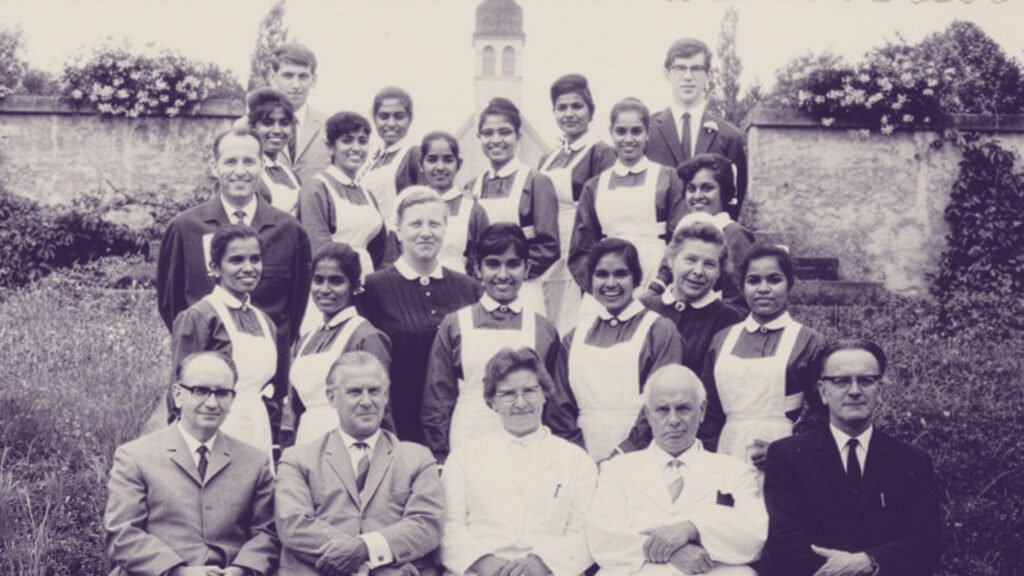
Care crisis and rescue from Asia
Recruitment came from private, religious, and state institutions. Nurses primarily came from three Asian countries:
-
South Korea
-
Philippines
-
India
In all three cases, it was mostly Young women.Having just finished school, leaving home for the first time with a few clothes in their suitcase, the hope for a good education and the opportunity to financially support their family with it.They embarked on a journey that would permanently change their lives – and the German healthcare system.
German migration policy
There are no reliable figures how many healthcare workers took this route to migrate from India. Most, however, as far as it is documented, came from of South Indian state of Kerala State, home to India’s largest Christian population. Recruitment was carried out mainly by denominational hospitals and institutions, which provided for their training and accommodation.
Many women entered the country on fixed-term contracts. In the early 70s, the labour market became tighter again, and the Migration policy in West Germany became restrictive. In 1977, some nurses received a notice that their work and residence permits would expire in one year.
For many, this was a shock. They had built a life for themselves in Germany, married, brought their husbands to Germany, had children. Their families in India were counting on the so-called Remittances They rely on their salaries. Furthermore, the West German training for nurses was not recognised in India.
Some of the women resisted – with petitions and open letters, partly supported by their employers and colleagues – and were able to stay. Others emigrated permanently or later returned to Europe on individual contracts.
Whether they stayed, moved on, or returned: their stories mark the The launch of WHO CARED.
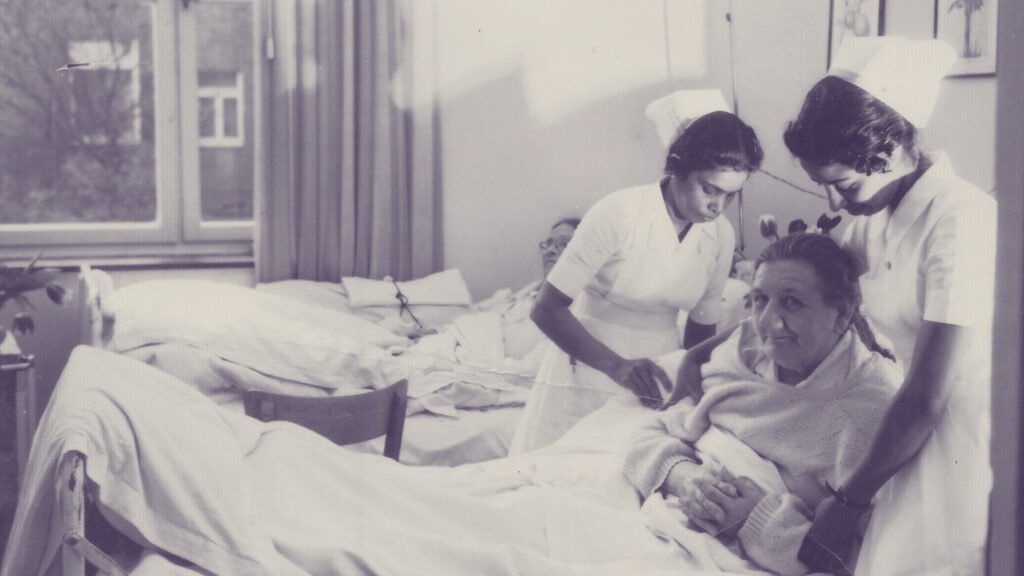
„Brown Angels“ and the origins of WHO CARED
The cultural anthropologist Urmila Goel is among the few scientists who have been researching the migration of nurses from Kerala to Germany since the late 1990s. Her research has significantly contributed to making this previously overlooked history visible and also forms an important foundation for WHO CARED.
In 2013, Keralite filmmaker Shiny Jacob Benjamin released the documentary film Translated Lives – A Migration Revisited. The film tells the story of young women who left their homeland at the age of 15 or 16 – at a time when such a step was hardly imaginable for women. Although the film is set in Germany, it was originally aimed at an Indian audience. Benjamin describes the particular dimension of this migration with the words:
“At a time when girls were not allowed to even set foot beyond their school or home, these girls were sent off to a foreign land. I believe it is also the first women's migration ever to have occurred in the history of migration.”
For a European audience, the film was later re-edited by Manoj Kurian (Masala Movement e.V.) and Ahjosh Elavumkal. Both are part of the WHO CARED team. In conjunction with this, a companion booklet was also created, which further elaborates on the historical background and personal stories.
As part of this further development, the photo exhibition Sister Kerala was also Schwester Kerala initiated. The community was called upon to submit private archive photos of their mothers – a collective process that makes personal memories visible and places them in a larger historical context. The exhibition was curated by Manoj Kurian and Vineetha Panalickal.
The term Brown Angels, according to the husband of one of the nurses, was occasionally used to refer to the women – an expression of appreciation for their work and their presence in a foreign country.
Building on these projects and many years of research, the idea for WHO CARED eventually took shape: a digital archive that collects, preserves and makes accessible the stories of these women – for their families, for the public and for future generations.
The Kerala case
Kerala has had a strong Tradition in education and healthcare. Christian missions established hospitals and nursing schools early on. As a result, nursing developed into a recognised, professionalised career, particularly for women.
At the same time, the profession offers domestically little economic security.Low wages, high workloads and limited career progression are therefore among the so-called Push factors for migration in this area.
Among the pull factors is the persistently high international demand after nursing staff, especially from Europe, North America and the Gulf States, better pay and working conditions. Migration is supported by church, institutional and family networks, which facilitate training, placement and arrival abroad.
However, migration patterns linked to nursing professions on the one hand, and the historical focus on health on the other, have also led to Kerala's healthcare system is now being considered one of the best in the country. The people in the South Indian state live the longest on average, and the combination of traditional medicine such as Ayurveda with modern medicine makes the state a popular destination for medical tourism.
Care Migration Today
By 2049, Germany will face a shortage of between 280,000 and 690,000 Caregivers .. Even today, almost One in five nurses are from abroad. The number of employees from India in the entire healthcare sector has increased tenfold since 2015.
Since 2013, the Federal Employment Agency and the GIZ have been advertising through the so-called Triple-Win Agreement targeting nurses from third countries.From 2023, young people from Kerala will once again be recruited to complete their vocational training in Germany and work here. The GIZ had previously carried out a pilot project on this.
The agreement is intended to benefit three parties:
-
the German healthcare system
-
the recruited nurses
-
the countries of origin
To preserve brain drain and preserve global health care systems Brain-Drain to preserve, the WHO is conducting a study on a List of vulnerable countries. Following the amendment of WHO criteria in 2023, India is no longer on this list.
Further selected sources
- Recruiting Nurses from Kerala: On Gender, Racism, and the Nursing Profession in West Germany, Papers by Urmila Goel – Humboldt University of Berlin
- ‚In Germany's Interest‘: State Responses to Transnational Nurses
Recruitment“, Papers by Urmila Goel – European Journal for Nursing History and Ethics - Asiannurses.de – Urmila Goel's research website – Asiannurses.de
- Who Cares? Care Extraction and the Struggles of Indian Health Workers, a scientific book, edited by Maya John and Christa Wichterich – academia.eu
- Skilled worker migration – Nursing shortage – Charity, Dissertation by TobiasSantosh Grossmann Springer versus
- From Kerala to Germany: Care Labour Migration in the 1960s, Video by Tobias Grossmann and Daniel Teixeira about Grossmann's research, which also tells his own story – YouTube
- Invisible, indispensable., Scientific book by Philomina Bloch-Chakkalakkal – Seismoverlag
- Magazine Archive Meine Welt, 1984 – 2022 by the German-Indian Cooperation Association e.V. Access to the archive requires a password, which can be obtained from meinewelt@diz-ev.de can request – My World Online
- Factsheet Foreign doctors and nurses – Media Service Integration
- WHO Report Migration of nursing and midwifery in Kerala (India) – Whom
- Mary, short film by Nevin George, which tells the story artistically – Vimeo